
How to Screen Catalysts for Your Application
Choosing a catalyst is not just a search for the highest activity. The right material must also fit your feedstock, reactor, operating temperature, and production targets. That is why catalyst screening should begin with a clear application question. Are you prioritizing conversion, selectivity, lifetime, or cost? These goals can point to different winners. Nobel laureate Frances H. Arnold’s concise principle, “You get what you screen for,” captures the stakes. A screen rewards the outcomes its tests measure—and may miss the properties they ignore.
Turn the application into measurable criteria before testing candidates. Compare catalysts under realistic conditions, including representative feed composition, temperature, pressure, and contact time. Track activity and selectivity, but also note deactivation, regeneration needs, and material handling. Small details matter. A catalyst that performs well in a clean laboratory feed may behave differently when impurities are present. Keep controls, replicates, and test records; otherwise, a ranking can reflect experimental noise rather than a real material advantage. Still, no screening plan is perfect. Early tests simplify a complicated process, and that simplification can hide useful clues. Treat the first ranking as a decision aid, not a verdict. The strongest candidate is the one that survives increasingly relevant tests and remains practical for your application.
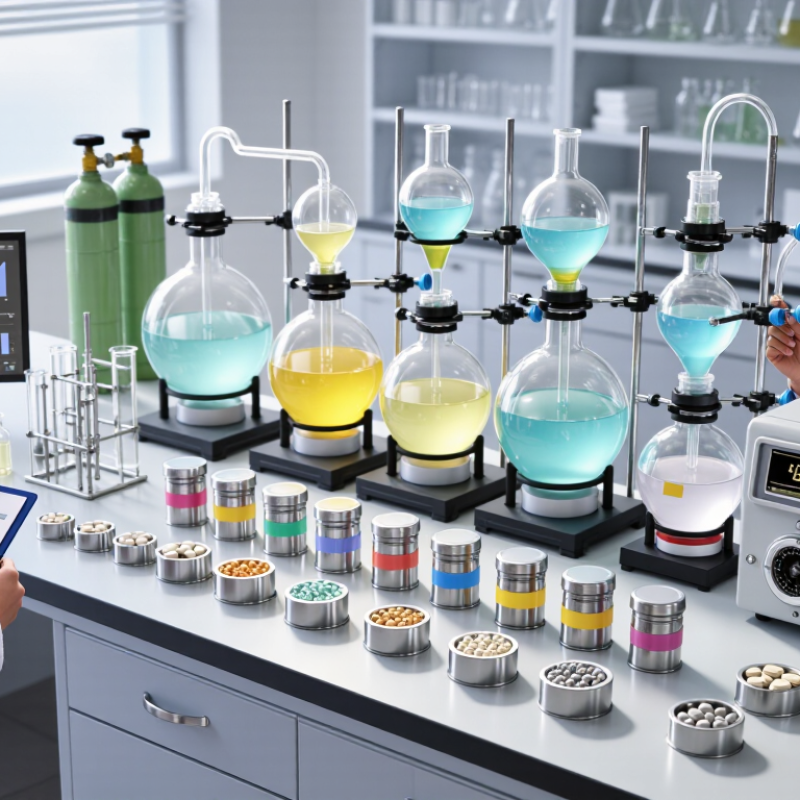
Define the Application Requirements and Operating Conditions
A useful catalyst screen starts with the job the catalyst must perform. Define the target conversion, selectivity, product quality, and acceptable operating cost before comparing samples. Then describe the real process window: feed composition, temperature, pressure, flow rate, and expected run time. A catalyst that performs well at one temperature may lose selectivity when the feed contains water or trace contaminants. Small details matter. A few degrees can change the result.
Translate those needs into a controlled test plan. Use representative feed where practical, and record pretreatment, particle size, and space velocity; each can affect measured performance. Track temperature at the catalyst bed, not only at the heater, because local hot spots can distort results. Compare candidates against the same baseline and repeat key runs. Even a careful plan can miss an operating constraint, so revisit assumptions when lab results conflict with process data. Screening narrows choices; it does not guarantee full-scale performance.
Tips: Write down minimum performance limits before testing. Change one variable at a time, and log every condition. Keep a sample of the original feed for comparison. If a result looks unusually strong, repeat it before drawing a conclusion.
How to Screen Catalysts for Your Application - Define the Application Requirements and Operating Conditions
Use the representative ranges below to define an initial screening window. Actual conditions depend on feed composition, reactor design, heat and mass transfer, safety limits, and product specifications.
| Application | Primary Performance Requirements | Representative Catalyst Families | Typical Initial Operating Window | Key Feed or Process Constraints | Screening Measurements | Important Deactivation Risks |
|---|---|---|---|---|---|---|
| Hydrogenation of unsaturated organic compounds | High conversion and selectivity; low by-product formation; stable activity over repeated operation | Supported nickel, palladium, platinum, or copper catalysts, selected for the substrate and required selectivity | Approximately 20–200 °C; hydrogen partial pressure from near atmospheric to several MPa, as appropriate to the process | Check sulfur, halides, water, and other catalyst poisons; consider hydrogen solubility and gas–liquid mass transfer | Conversion, target-product selectivity, hydrogen uptake, by-product profile, and activity after repeated runs | Sulfur poisoning, metal leaching, sintering, carbon deposition, or loss of selectivity |
| Selective oxidation of organic feedstocks | High selectivity to the desired oxygenated product; controlled heat release; limited over-oxidation | Supported silver, vanadium-based mixed oxides, or other metal-oxide catalysts tailored to the reaction | Often about 150–450 °C; oxidant concentration and residence time must be controlled for the specific reaction | Assess oxygen concentration, flammability limits, feed purity, heat removal, and the effect of steam or water vapor | Conversion, selectivity, carbon balance, temperature profile, and oxygen utilization | Hot spots, over-oxidation, phase changes, fouling, or loss of active surface area |
| Steam reforming of light hydrocarbons | High hydrogen yield; low methane slip; resistance to carbon formation | Nickel supported on alumina, magnesium aluminate, or other thermally stable oxide supports | Commonly about 650–900 °C at pressures ranging from near atmospheric to several MPa; steam-to-carbon ratio is process-specific | Control sulfur in the feed; define steam-to-carbon ratio and pressure; account for endothermic heat demand | Hydrogen yield, methane conversion, carbon balance, pressure drop, and activity during extended operation | Carbon deposition, sulfur poisoning, nickel sintering, and thermal cycling damage |
| Carbon monoxide shift conversion | Reduced carbon monoxide concentration with suitable hydrogen production and steam utilization | Iron-oxide-based catalysts for higher-temperature operation; copper-oxide-based catalysts for lower-temperature operation | Higher-temperature stage: roughly 300–450 °C; lower-temperature stage: roughly 180–250 °C | Manage steam-to-gas ratio, inlet temperature, sulfur and chloride contaminants, and condensation during cooling | Carbon monoxide conversion, hydrogen concentration, temperature rise, and resistance to start-up or shutdown cycles | Thermal sintering, copper oxidation-state changes, sulfur poisoning, or condensation-related damage |
| Ammonia synthesis | High rate at practical pressure and temperature; stable activity; tolerance of specified feed impurities | Promoted iron catalysts or ruthenium-based catalysts on suitable supports | Industrial synthesis commonly operates at about 350–500 °C and 10–30 MPa; screening conditions depend on reactor and test scale | Maintain the required hydrogen-to-nitrogen ratio; remove water, oxygen, carbon oxides, and sulfur-containing impurities | Ammonia formation rate, equilibrium approach, pressure dependence, and activity after impurity exposure | Poisoning by oxygen-containing or sulfur-containing species, sintering, and loss of promoter effectiveness |
| Biomass-derived feed upgrading | High oxygen removal and desired liquid-product yield; manageable hydrogen consumption; low solids formation | Supported nickel, cobalt, molybdenum-based sulfide, or noble-metal catalysts, depending on feed and product targets | Often about 200–450 °C under hydrogen pressure; actual severity depends strongly on feed oxygen content and phase behavior | Characterize water, oxygenates, ash, alkali metals, nitrogen, sulfur, and solids; define hydrogen availability and feed pretreatment | Liquid yield, oxygen removal, hydrogen consumption, gas and coke formation, and product stability | Coking, mineral deposition, pore blockage, water-related changes, and poisoning by nitrogen or metals |
Related Posts
-
China Best Catalyst Testing Services for Global Buyers
-
How to Choose the Best Catalyst Screening Service?
-

How to Accelerate Your Catalysis Research for Breakthrough Discoveries
-

Top 10 Catalysts for Enhancing Global Procurement Efficiency?
-
2026 Top Catalyst Screening Techniques for Efficient Procurement?
-
China Top Catalyst Suppliers for the Catalyst Industry