
How to Choose the Best Catalyst Screening Service?
Choosing the right catalyst screening service can shape an entire research program. A fast result is useful, but speed alone proves little. Reliable catalyst screening should connect experimental design, analytical accuracy, and practical decision-making. The best provider understands your reaction, substrate sensitivity, production goals, and safety requirements before testing begins.
Look for clear evidence of technical experience. Can the team screen metals, ligands, solvents, bases, or additives systematically? Do they use suitable controls and replicate promising results? Details matter. A 96-well plate may reveal useful trends, yet small-scale results can change during scale-up. Ask how the service measures conversion, selectivity, impurity formation, and catalyst stability. Techniques such as GC, HPLC, NMR, or ICP-MS may each answer different questions. Raw chromatograms and complete experimental records should be available.
Transparency builds trust. A credible provider explains limitations, unexpected results, and data quality instead of hiding weak outcomes. No service is flawless. That matters. A polished report cannot replace sound interpretation, and attractive conversion numbers may conceal poor selectivity. Review the company’s scientific publications, quality systems, communication process, and experience with similar chemistry. Confirm ownership of samples, data, and intellectual property before work starts. Cost also deserves careful thought; the cheapest screen may create expensive delays later. The strongest choice balances expertise, reproducibility, turnaround time, communication, and the evidence needed for confident next steps.
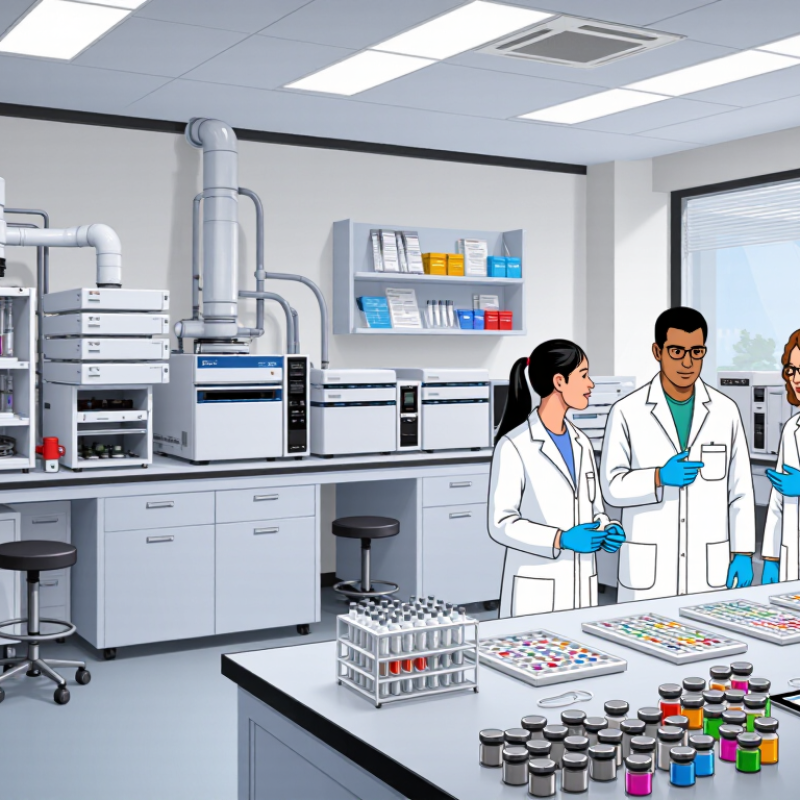
Define Screening Goals: Activity, Selectivity, Stability, and Scale-Up Targets
How to Choose the Best Catalyst Screening Service?
Define Screening Goals: Activity, Selectivity, Stability, and Scale-Up Targets
A reliable screening project starts with measurable goals, not a broad request for “the best catalyst.” Define the required activity, such as conversion percentage, reaction time, or turnover frequency. Specify selectivity targets for the desired product and unwanted by-products. Include temperature, pressure, solvent, substrate concentration, and sampling intervals. These details help the service design relevant experiments instead of producing attractive but impractical data.
Stability needs equal attention. Ask how long the catalyst must remain active and which deactivation signs will be monitored. Useful checks include metal leaching, particle changes, fouling, and performance across repeated cycles. A first screen rarely answers everything. Some early assumptions may prove wrong, especially when laboratory results meet real feedstocks. That is worth discovering early.
Tips: Request raw data, control reactions, replicate results, and clear analytical methods. Confirm detection limits and calibration procedures. Ask whether the team can test different catalyst loadings and identify a realistic scale-up path. Small reactors may hide mixing, heat-transfer, or mass-transfer problems. Include a staged plan, moving from rapid screening to longer stability runs and larger reaction volumes. Leave room for revision. The most promising catalyst may fail during scale-up, while a less impressive candidate may offer better consistency, safety, and process control.
| Screening Goal | Primary Metrics | Recommended Measurement Approach | Indicative Data Output | Example Decision Target | Key Controls | Scale-Up Relevance |
|---|---|---|---|---|---|---|
| Activity | Conversion Reaction rate TOF Productivity | Use a controlled batch or continuous-flow reactor. Quantify reactants and products using GC, HPLC, LC-MS, titration, or calibrated gas analysis, depending on the reaction chemistry. | Conversion (%), initial rate (mol·g−1·h−1), turnover frequency (h−1), mass-time yield, and productivity (kg product·kg catalyst−1·h−1). | Select catalysts that meet the required conversion at the intended temperature, pressure, residence time, and catalyst loading. Compare rates at equal conversion where possible. | Blank reactor, no-catalyst run, known reference material, replicate experiments, calibrated analytical method, and mass-balance closure. | Indicates whether the catalyst can achieve the required throughput without excessive catalyst volume or residence time. |
| Selectivity | Product selectivity Yield By-products Carbon balance | Identify and quantify desired products, intermediates, and major by-products using chromatographic or spectroscopic methods with authentic standards or validated response factors. | Selectivity (%), product yield (%), impurity profile, by-product formation rate, and carbon or elemental balance. | Set a product-specific threshold, such as selectivity of at least 95% at the required conversion, rather than evaluating selectivity at very low conversion. | Product standard, response-factor verification, replicate injections, feed impurity check, and consistent sampling time. | High selectivity can reduce separation duty, recycle load, waste generation, and downstream purification cost. |
| Stability | Time-on-stream Deactivation rate Regeneration Leaching | Operate the catalyst under representative conditions in a continuous-flow reactor. Track activity and selectivity over time and analyze spent catalyst and effluent for structural changes or active-component loss. | Conversion versus time, selectivity versus time, deactivation rate (%·h−1), pressure drop, elemental leaching, coke or deposit content, and performance after regeneration. | Define a project-specific stability period, for example maintaining at least 90% of initial activity over 100 hours, with no unacceptable selectivity drift or pressure-drop increase. | Constant feed composition, temperature and pressure logging, flow calibration, material balance, duplicate runs, and post-test characterization. | Reveals catalyst replacement frequency, regeneration requirements, operating risk, and expected campaign length. |
| Scale-Up Readiness | Productivity Heat transfer Mass transfer Pressure drop | Progress from small batch or microreactor tests to a representative packed-bed, slurry, or stirred-tank configuration while preserving relevant flow, mixing, heat-transfer, and catalyst-form factors. | Space-time yield, catalyst volume, residence-time distribution, temperature profile, pressure drop, particle attrition, filtration behavior, and scale-dependent selectivity. | Demonstrate reproducible performance at increased catalyst quantity or reactor volume, with acceptable thermal gradients, pressure drop, handling properties, and safety margins. | Same feed preparation, comparable catalyst particle size, equipment blank, thermal calibration, residence-time verification, and independent mass balance. | Supports reactor sizing, equipment selection, process-control strategy, catalyst shaping, and pilot-test planning. |
| Reproducibility | Run-to-run variation Batch variation Confidence interval | Repeat the complete screening workflow using independently prepared catalyst portions and, where relevant, different catalyst synthesis batches. | Mean, standard deviation, coefficient of variation, confidence interval, outlier review, and repeatability of activity and selectivity. | Establish an acceptance limit before testing, such as a coefficient of variation below 5% for a key analytical result when the method and process allow it. | Randomized run order, identical sample pretreatment, instrument suitability checks, internal standards, and documented deviations. | Reduces the risk that scale-up decisions are based on a single anomalous experiment or an unrepresentative catalyst preparation. |
| Catalyst Characterization | Composition Surface area Porosity Structure | Combine elemental analysis, powder X-ray diffraction, gas physisorption, microscopy, thermal analysis, chemisorption, or acidity/basicity measurements as appropriate for the catalyst system. | Active-element loading, crystallite phase, surface area, pore volume, pore-size distribution, particle morphology, oxidation state, dispersion, and thermal stability. | Confirm that the selected catalyst has the intended composition and physical properties, and correlate these properties with activity, selectivity, and durability. | Certified or traceable standards where applicable, instrument calibration, sample drying protocol, representative sampling, and replicate characterization. | Helps define catalyst specifications, identify scale-up-sensitive properties, and establish quality-control tests for future production batches. |
| Safety and Process Compatibility | Thermal behavior Pressure Corrosion Waste profile | Review reaction exothermicity, gas evolution, operating pressure, feed compatibility, catalyst handling, and the chemical compatibility of reactor and sampling materials. | Heat-release indicators, maximum temperature, pressure response, gas composition, corrosive species, hazardous by-products, and catalyst disposal requirements. | Operate within defined temperature and pressure limits and demonstrate that heat removal, gas handling, containment, and waste treatment are suitable for the intended process. | Safety review, pressure testing, temperature interlocks, calibrated sensors, appropriate ventilation, and documented operating procedures. | Identifies hazards and engineering constraints before larger quantities of catalyst, solvent, reactant, or product are introduced. |
Related Posts
-

7 Best Catalysis Research Companies for Global Buyers?
-
Why Are Catalytic Reactions Important in Chemical Processes?
-

2026 Top Trends in Chemical Manufacture Innovations and Advancements?
-

2026 Top Innovations in Chemical Manufacture Industry Trends?
-

Top 10 Breakthroughs in Catalysis Research You Need to Know?
-

Top 10 Innovations in Chemical Manufacturing for a Sustainable Future?