
What Is Ti-6Al-4V Grade 5 Titanium Bar?
Ti-6Al-4V (Grade 5) Titanium Bar is a widely used titanium alloy product, valued for its combination of strength, low weight, and corrosion resistance. Grade 5 contains aluminum and vanadium, which help give the alloy its characteristic strength and heat-treatable α+β structure. The bar form is supplied for machining, fabrication, and parts used in demanding environments. But “titanium” alone does not tell the whole story.
Materials author Matthew J. Donachie’s technical work supports a practical principle: performance depends on processing and material condition, not chemistry alone. This is a paraphrase, not a verbatim quotation. For buyers and engineers, that distinction matters. A bar’s dimensions, applicable specification, heat treatment, and inspection records can all affect whether it suits a particular job. A bright surface is not proof of internal quality. Nor does a familiar grade name guarantee identical properties from every supplier.
This guide explains what Grade 5 titanium bar is, how its composition relates to its behavior, and where it is commonly selected. It also considers machining and purchasing details, including documentation worth checking before material enters production. There are trade-offs. The alloy can be difficult to machine compared with many steels, and the right choice depends on service conditions, design, and budget. Those details are easy to overlook. The goal is a clear, practical understanding—not the claim that one alloy fits every application.
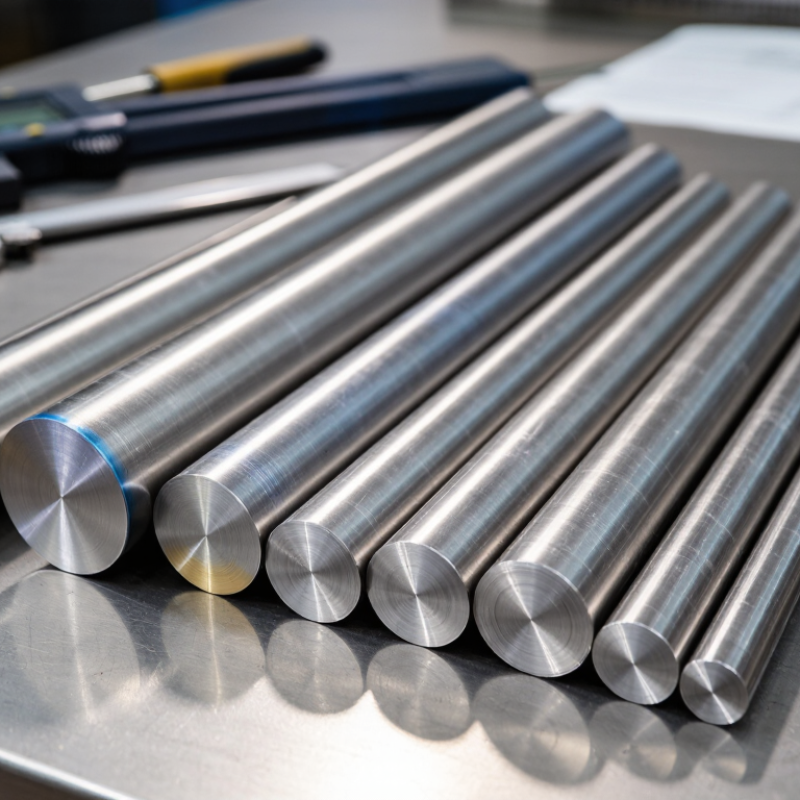
What Is Ti-6Al-4V Grade 5 Bar? Its 6% Aluminum–4% Vanadium Composition
Ti-6Al-4V Grade 5 bar is a titanium alloy containing aluminum and vanadium. The name is literal. ASTM B348/B348M specifies 5.5–6.75% aluminum and 3.5–4.5% vanadium by mass for Grade 5, with titanium making up most of the remainder. The specification also limits elements such as oxygen and iron, because small chemistry changes can affect performance. These ranges matter: the alloy is not always exactly 6% aluminum and 4% vanadium.
Aluminum stabilizes the alpha phase, while vanadium stabilizes the beta phase. Together, they create an alpha-beta alloy valued for strength and moderate weight. The ASM Handbook, Volume 2, reports a density of about 4.43 g/cm³ for Ti-6Al-4V. That is roughly 60% of steel’s density, though the comparison does not tell the whole story.
A bar’s properties also depend on its processing and heat treatment. A useful caution: composition alone cannot predict how a finished bar will machine or perform. Check the material test report against the applicable ASTM requirements.