China Top Powdered Beets Benefits for Global Buyers?
Powdered Beets Benefits attract global buyers seeking convenient ingredients for beverages, smoothies, and food formulations. The powder is lightweight, easy to blend, and simpler to store than fresh beets. Its natural red color can also add visual appeal. Still, benefits depend on the product and its intended use.
Beetroot contains dietary nitrate, a compound studied for its role in nitric oxide production and exercise performance. Professor Andy Jones, a sports physiologist known for research on dietary nitrate, has explored this connection. A fair paraphrase of his research is: “Dietary nitrate may reduce the oxygen cost of exercise.” That is a possibility, not a guaranteed outcome. Processing, serving size, and individual differences can all affect results.
For buyers, careful sourcing matters as much as a promising label. Ask suppliers for the ingredient’s origin, processing method, product specifications, and current batch test documentation. Check color, aroma, solubility, and consistency in a sample before placing a large order. Details matter. A vivid red powder may look impressive, but appearance alone cannot confirm quality or nutritional value. Not every batch performs the same way. Storage conditions and moisture can change the finished product, too. These details are easy to overlook, and they deserve a second look. This guide examines Powdered Beets Benefits alongside practical considerations that help buyers assess products with care.
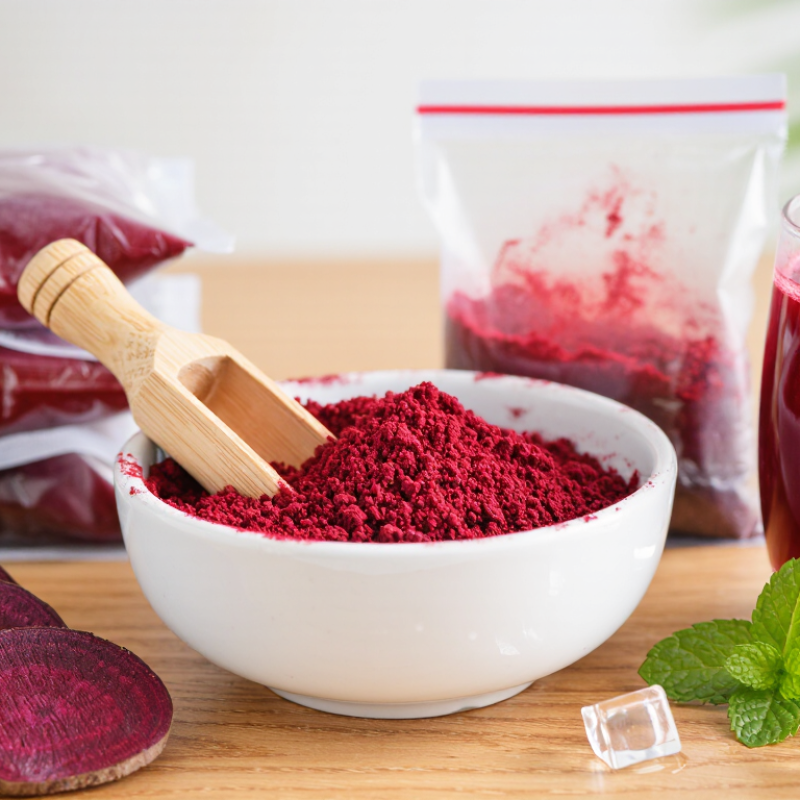
Beetroot Powder Explained: Forms, Processing, and Common Global Uses
Beetroot powder is not one uniform ingredient. Whole-root powder is made from cleaned, dried beets that are milled into a fine, earthy powder. Juice powder starts with extracted beet juice, which is concentrated and dried; some versions include a carrier to improve flow and handling. Check the ingredient declaration, since the carrier affects how the powder behaves in a recipe. Processing changes color, flavor, and solubility. Spray drying can produce a free-flowing powder, while gentler drying may preserve a deeper beet character. Small details matter.
In drinks, powder can add a red-violet hue and a mild, earthy taste. In bread, noodles, soups, and seasoning blends, it offers color without fresh beet pieces. It may disperse unevenly in cold water, so a small bench test can reveal clumping before production. Ask suppliers for specifications covering moisture, particle size, microbiological quality, and relevant contaminant testing. Natural color can vary between harvests. A vivid sample can still behave differently in a finished product, especially when acidity or heat changes the shade. That deserves a real recipe trial, not just a bright-looking sample.
Nutrient Profile: USDA Reports 43 kcal per 100 g of Raw Beetroot
USDA FoodData Central lists raw beetroot at 43 kcal per 100 g. That figure describes fresh beetroot, not powdered beet. Raw roots contain plenty of water, spreading their calories across a moist, firm slice. Powder has had much of that water removed, so a small spoonful may represent more beetroot solids than its volume suggests. That distinction matters. For global buyers, the USDA figure is useful context, but not a direct calorie value for every powder. Drying methods, residual moisture, and serving size can all affect the final nutrition figures.
A practical comparison starts with the nutrition panel and a clearly stated serving weight. Check whether the data refer to raw beetroot or finished powder, and ask for batch-specific analysis when available. A level teaspoon and a 100-gram portion of raw beetroot are not equivalent measures. Color and texture offer clues at the receiving dock, but they cannot confirm nutrient levels. Even a careful comparison has limits: processing can change the product, and labels may use different serving sizes. The raw-root figure is a starting point, not the whole picture.
Potential Benefits: A Trial Found 2.8% Faster Cycling After Beetroot Juice
A reported trial found cyclists finished 2.8% faster after consuming beetroot juice. That result is interesting, not universal. It reflects one study’s conditions and does not guarantee the same gain from every beet product. Beetroot’s dietary nitrate can support nitric oxide production, which may influence blood flow and exercise efficiency. Responses vary. Training status, dose, timing, and individual biology all matter. A small percentage can also depend on how performance is measured.
Powdered beetroot deserves a closer look because it is not automatically equivalent to juice used in a trial. Variety, growing conditions, processing, and storage can change nitrate levels. For buyers, useful checks include a batch-specific certificate of analysis and testing for nitrate content, microbes, and heavy metals. Ask how the powder was dried, too. That detail is easy to miss. I would treat the 2.8% figure as a research clue, not a purchasing promise; the study’s exact product and protocol matter. Clear documentation makes comparisons more reliable, though it cannot erase differences between studies or individual athletes.
Nitrate Safety: EFSA Sets an Acceptable Daily Intake of 3.7 mg/kg Body Weight
For global buyers, beet powder offers concentrated color, earthy flavor, and naturally occurring nitrate. But nitrate levels can vary with beet variety, growing conditions, harvest timing, and processing. A red scoop does not reveal its nitrate content. Buyers should request batch-specific laboratory results and clear serving instructions before comparing suppliers.
EFSA established an acceptable daily intake for nitrate of 3.7 mg per kilogram of body weight. For a 70-kilogram adult, that equals 259 mg daily from all dietary sources, not beet powder alone. The ADI is a guide for regular, long-term intake; it is not a recommended target or a precise boundary between safe and harmful exposure. That matters. Leafy vegetables and drinking water can also contribute nitrate, so a powder’s share depends on the full diet. Ingredient specifications should state measured nitrate levels, test methods, and serving size. Even careful estimates have limits: lab results describe tested samples, while natural ingredients can vary between batches. Buyers should avoid assuming that “natural” means nitrate-free or that more powder brings greater benefit. Individuals with health concerns can seek advice from a qualified health professional.
China Supplier Checks: Verify COAs, Microbiology, Traceability, and Certifications
China Top Powdered Beets Benefits for Global Buyers?
China Supplier Checks: Verify COAs, Microbiology, Traceability, and Certifications
Powdered beet can offer buyers consistent color and convenient handling, but supplier documents deserve close review. Request a COA tied to the exact lot, not a generic sample. Check its issue date, test methods, and measured results. A clean-looking PDF is not proof by itself.
Review microbiological results against your own product requirements. Confirm which organisms were tested, when the sample was taken, and whether the report identifies the production lot. Ask how the supplier controls moisture and prevents contamination during packing. Details matter. Traceability records should connect beet raw material, processing dates, lot codes, and shipment documents. Certification claims also need checking: verify the issuing body, validity period, facility, and product scope. A certificate may cover less than its headline suggests. Even a careful review can miss a mismatch, so clarify anything unclear in writing.
Tips: Request a recent lot-specific COA and a sample traceability record. Match lot numbers across documents. If results use unfamiliar methods, ask for an explanation before approval. Keep your questions specific; vague answers are hard to assess.
